

The First Attack from Hell
My brain was stolen and replaced by something I didn't know

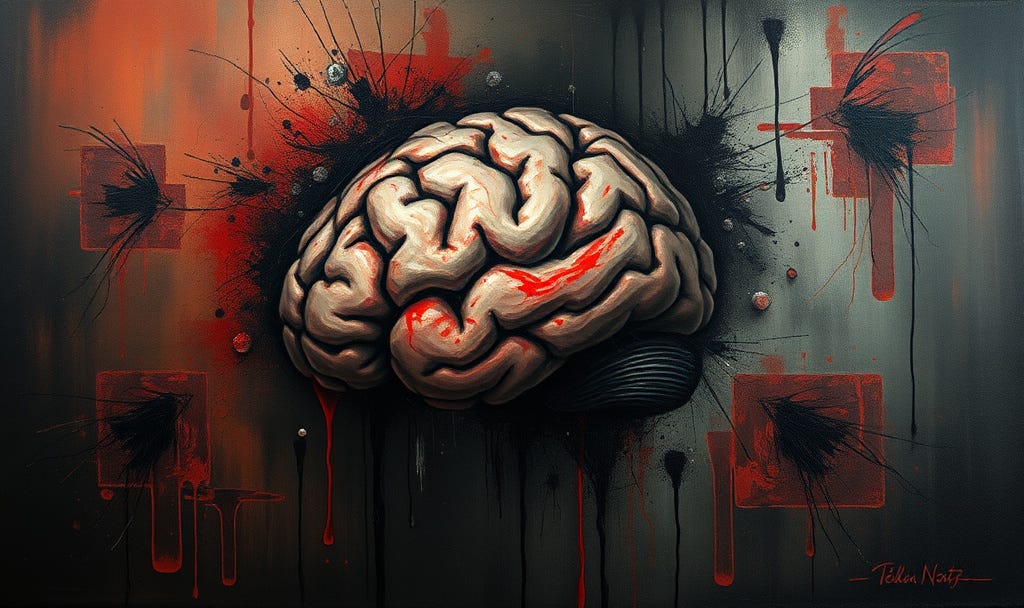
In my late twenties and early thirties, I went through three extremely difficult periods. Now I see they were all necessary because they led me to places — mentally and physically — that I otherwise wouldn’t have reached. Yet, at the time, all I could feel was the suffering.
I was 28 when I hit my forehead hard against the lower part of a first-floor balcony and fell to the ground.
It was a Saturday. I had just been to the market and was heading back to my small but cozy apartment in one of the cheapest neighborhoods in the Bulgarian capital, Sofia.
As I wasn’t working on Saturdays, I had planned a long afternoon of leisure. I could already taste the pleasure of eating homemade white rice with vegetables for lunch, followed by writing my new novel, and then sprawling in front of the TV with a bag of unhealthy chips. I was watching ‘House, M.D.’ at the time. Do you remember the show? I was absolutely in love with the limping genius doctor.
All those near-future — and along with them, the distant-future plans — were blown away in one single second.
In one single hit and in a fall.
I remember I remained on the ground for a long time, groceries scattered around me, their smell tinged with sourness and overripeness. Strangely, nobody passed by. The neighborhood was eerily quiet. I remember being aware of the violet darkness of the autumn sky, the heaviness of the air, and the hardness of the broken tiles beneath my back. I was also conscious of my own body: it lay there, tingling with cold and slight pain.
I was conscious of it, but I couldn’t move it.
I suddenly realized that my brain couldn’t command my body to move.
Somehow, the signals needed to bend my limbs and exert force to lift my body weren’t being sent.
For a moment, I freaked out. My first thought was that I was paralyzed, but no — I could feel my body, so it wasn’t that.
It was my brain I couldn’t feel.
It took me maybe an hour, maybe more, to be able to form a single thought:
Get up! Move!
I did it — extremely slowly, stumbling and falling a couple of times. Eventually, leaving all the groceries behind, I dragged myself to my apartment, thankfully located in the next building.
Once inside, I sprawled on the bed, feeling as though I had just crossed the entire Sahara Desert.
I desperately wanted to fall asleep, and I was drifting off when a cold sense of terror kept me awake. I knew something was wrong, but I wasn’t sure how wrong it was until I reached out for my phone and dialed — emergency speed — my mom’s number. When she picked up, the only word I could pronounce was,
“Mom…”
Nothing more
My brain couldn’t think of anything else.
I could feel the words in my head moving slowly, very slowly, like white clouds on a calm summer day, but they couldn’t reach my mouth.
I couldn’t make my vocal organs work.
And then again, “Mom…”
I dropped the phone on the ground.
She and Dad arrived two hours later from Plovdiv. At the time, I had many friends in Sofia, but I didn’t feel like calling any of them. I only wanted to call my parents.
I spent a week in a neurological hospital ward and was diagnosed with a cognitive brain concussion compounded by vestibular and ocular issues. Translation: I couldn’t think, speak, move, or see normally. I felt dizzy and sleepy all the time, and the world had turned into an excessively bright place where lights seemed to come from everywhere, blinding and hurting me.
I spent almost a month not leaving my darkened room in Plovdiv, and most of that time I was sleeping. When I wasn’t sleeping, I was raging against God.
The thing is, I had settled nicely in Sofia. For the last five years, I worked in one of the best English language schools in the capital. I had a good salary, independence, nice clothes, and traveled around Europe. I had plans for the future that included seriously looking for a partner — I no longer cared if they were Christian or not, because I had many disappointments in that direction — I just wanted to find someone and start a family, making my life perfect.
The school I was working at, politely informed me that they couldn’t grant more than two months of absence. If I needed additional time to recover from the concussion, I would have to resign. ‘No hard feelings,’ they said, ‘but our students pay high tuition fees and require a stable teacher. We can’t keep substituting teachers indefinitely.’
One month had passed, and still, I could barely walk around the apartment. I couldn’t look at an open book without getting a horrible headache, and reading… well… I could see the black squiggles looking like weird ants on the page, but they conveyed no meaning.
My brain had forgotten how to read.
Oh, and I had started a very promising novel before the incident. What was going to become of it?
So, I sat there in the room, raging against God and accusing Him of cruelty, madness, perversion, and whatnot. A friend from the church in Sofia had told me they were praying for me. I told them to stop praying because I didn’t care about a God who could do something like that to me.
That was when, after resigning from work and moving back to Plovdiv, I stopped attending church. I kept in contact with my friends, but the church now seemed completely meaningless.
Just like life in general.
Winter passed in solitude. In spring, I began taking longer walks around town and started to learn how to read again. I still remember it — wearing my newer, stronger glasses, sitting on the balcony, and connecting syllables. ‘Un-der-stand’, ‘gar-den’, ‘in-doors’. I would pronounce the word aloud and then give my brain time to grasp its meaning. And then move on to the next one. And the next one.
In June, I managed to read my first book — it was the first book of ‘Narnia’. I had the whole collection in Bulgarian, in large print, and read it that summer for the first time. It had seemed childish to me in the past, and I had ignored it, but for a brain that was now no different from a child’s, it was a perfect choice.
The same month, I made a short trip to Sofia to gather some things from my previous, still-unrented apartment. There, on the street, in a very classic — and post-concussion way — I bumped into my future husband.
He leaped back to avoid falling, and politely asked,
‘Moving in? Want a hand with that?’
Actually, both his hands were full of groceries, but his charming smile and his green eyes quickly made me forget about the cosmic woe that had been draining me for the last nine months.
“I’m moving out,” I said, “but I’d appreciate the help. Thanks.”
The previous me, the girl who didn’t know what a brain concussion was, would have died of shame right there on the spot. She probably would have blurted out something like, ‘No, thanks, I’m good,’ or just smiled like an idiot without saying anything, and scared the handsome guy away.
The new me, though, didn’t give a damn about anything anymore.
We had coffee, and I quickly told him my whole story. He looked quite shocked and seemed worryingly curious about the medical side of things. ‘So, you can’t walk long distances?’ he asked. ‘Can you ride in a car? How long can you stay in front of a computer?’
I learned he had been working in Greece for two years and visited his parents in Sofia every other weekend. His parents lived two buildings away from my old apartment. It seemed we had been neighbors for five years without knowing it.
We said goodbye, swapping e-mails and phone numbers, but I didn’t expect him to contact me again. He seemed too frightened by my current condition, and besides, he was too cute. I had never had a guy that cute before.
I went back to Plovdiv, and, as a new being who didn’t give a damn about anything, forgot all about him immediately. To my surprise, he sent me an e-mail in a few days and asked me if I wanted him to come visit me in Plovdiv in two weeks.
And so it started. As impossible as it seemed, that man was genuinely interested in me. He came every weekend for the next two months and I understood that he: 1) Was clean, polite, well-educated, and well-traveled. At thirty-two, he had already visited most of the countries around the world. 2) Was an ardent orthodox believer. Whenever he saw an orthodox temple, he was right in to light a candle and pray. That confused me, because, having been ‘raised’ in my faith by protestants, I wasn’t prepared to accept a different Christian view. I’d rather accept an atheist. However, as much as I didn’t want to admit it, seeing him in those churches made me feel nice. It made me feel safe. 3) He wanted a wife. Not just a girlfriend. A wife. And kids. As fast as possible. I thought he was crazy to talk to me about these things on our fifth date but that also made me feel safe.
The same October, we got married (just signed in the City Hall and went to dinner with our parents afterward), and then I got pregnant.
I hadn’t fully recovered from the concussion yet, but I had started slowly to make peace with God again, seeing some purpose in the previously inexplicable disaster.
And my pregnancy should have been good news, shouldn’t it?
The journey will continue…
I'm so glad that painful experience is a distant memory now. :)
Is this a memoir?